Posted in Course Requirements

Readings

Monday/Wednesday class (any readings we don’t get to will revert to December 7)

Nov 28: Jon K, Matt Z, Logan, Keegan, Kylie, Austin, Judah

Nov. 30: Lucas, Gabby, Grant, Julie, Katelynn, Emma, Grant C.

Dec. 5: James, Evan, Derrick, Jack, Jackson, Lindsay

Dec. 7: FINAL PORTFOLIO IS DUE. (SEE BELOW)

Tuesday/Thursday class

Nov. 29: Julie, Andrew Addessi

Dec. 1: Vicky, Jenna, Abbey, Holly, Sarah Andrew Adamski

Dec. 6: Megan, Grace, Jay, Kimberly, Genvieve, Adam

December 8: FINAL PORTFOLIO IS DUE. SEE BELOW Vanessa, Daniella, MK, Liz, Paul

FINAL PORTFOLIO

Your final portfolio is due on the last day of class. It is worth 50% of your grade. It is graded on completeness and proper organization, as well as a good faith effort to complete all assignments, and following all directions. You are not required to revise anything in the portfolio. But if your packet was incomplete the first time you turned it in, you should include missing work IN A SEPARATE PACKET. Please label this packet “MISSED WORK.” Your zine will be returned to you with your final portfolio.

You MUST pick up your final portfolio at my office on the day/time of your final exam. My office is: 419 East Hall.

  • MONDAY/WEDNESDAY CLASS: Pick up portfolio between 6 pm and 9 pm on Monday December 12. 
  • TUESDAY/THURSDAY CLASS: Pick up portfolio between 6 pm and 8 pm on Tuesday December 13. 

HONORS STUDENTS: Don’t forget to include your short paper (see course requirements). You’ll need this to get honors credit. 

WHAT TO INCLUDE:

  • Your Creative Non Fiction Packet, secured with a small spring clip
  • Your Fiction Packet, secured with a small spring clip
  • All poems from poetry prompts, in the correct order, stapled together. Put the poem you like best ON TOP.
  • Packet of any missed work (work that was not turned in with your CNF or Fiction packets the first time). Staple missed work together and label it “MISSED WORK.”
  • A blank sheet of paper (for my comments). On this paper, write your name.
  • ON TOP OF EVERYTHING, please include short answers to the following questions:

1. Which piece are you the most proud of? Why?

2. Which piece gave you the most trouble?

3. Which piece surprised you the most?

4. What did you learn about writing this semester?

5. Will you continue to write? If so, what are your plans?

Posted in Class Assignments and Homework

Classroom Assignment, November 16-17

This is your last classroom assignment. Label it CLASSROOM ASSIGNMENT #15.

Write a poem about something you will never have. You may assume a persona, if you wish, and contemplate what your persona will never have.

This will be a modified palimpsest poem. You don’t have to follow the model poem exactly, but where you see a concrete detail, you should add a concrete detail. Where you see a memory, you should include a memory. Where you see a question, you should include a question. Where you see present tense, you should use present tense. And so on. Strive for ambivalence. This will create tension in your poem.

ambivalence: uncertainty or fluctuation, especially when caused by inability to make a choice or by a simultaneous desire to say or do two opposite or conflicting things.

In literature: 

The quality of balanced opposites that can provide form and unity to a literary work of diverse components. This sort of tension exists between contradictions in the text that the reader must resolve without authorial discussion.

Title your poem: The ______________ I’ll never have.

The Son I’ll Never Have 

rabbit

The Son I’ll Never Have

The son I’ll never have is crossing the lawn. He is lying on an imaginary bed, the coverlet pulled up over his knees-knees I don’t dare describe. I recoil from imagining him as meat and bone, as a mind and hands stroking the fur of his pet rabbit. I never gave him the accordion I used to play, my mother and I in duets: “The Minnesota Polka,” “What a Friend We Have in Jesus,” never watched him push noodles into his mouth with fingers while I wished he would use the spoon shiny with disuse. I am free from longing to be free; I do as I please, my money is my own, all the mistakes I make are only my mistakes. What is it to look at something you made and see the future? What is it to have someone made by your body, but whose mind remains just out of reach? I’ll never know. Come here, little rabbit. Eat these greens. I will pet your cloudy fur with the mind’s hand.

About this poem: ”This poem explores my deep ambivalence about not having children. As I have watched many of my friends become parents, I have had occasion to review the circumstances that have led to my own childlessness; this poem documents those considerations.” — Mark Wunderlich

About the poet: Mark Wunderlich is the author of “The Earth Avails” (Graywolf Press, 2014). He teaches at Bennington College and lives in Catskill, N.Y.

Copyright 2016 Mark Wunderlich. Originally published in Poem-a-Day, www.poets.org. Distributed by King Features Syndicate


Posted in Class Assignments and Homework

Class Assignment: November 14-15

CLASSROOM ASSIGNMENT #14

linenmummy

Mummy of a Lady Named Jemutesonekh

BY THOMAS JAMES

XXI Dynasty
My body holds its shape. The genius is intact.
Will I return to Thebes? In that lost country
The eucalyptus trees have turned to stone.
Once, branches nudged me, dropping swollen blossoms,
And passionflowers lit my father’s garden.
Is it still there, that place of mottled shadow,
The scarlet flowers breathing in the darkness?
I remember how I died. It was so simple!
One morning the garden faded. My face blacked out.
On my left side they made the first incision.
They washed my heart and liver in palm wine—
My lungs were two dark fruit they stuffed with spices.
They smeared my innards with a sticky unguent
And sealed them in a crock of alabaster.
My brain was next. A pointed instrument
Hooked it through my nostrils, strand by strand.
A voice swayed over me. I paid no notice.
For weeks my body swam in sweet perfume.
I came out scoured. I was skin and bone.
They lifted me into the sun again
And packed my empty skull with cinnamon.
They slit my toes; a razor gashed my fingertips.
Stitched shut at last, my limbs were chaste and valuable,
Stuffed with paste of cloves and wild honey.
My eyes were empty, so they filled them up,
Inserting little nuggets of obsidian.
A basalt scarab wedged between my breasts
Replaced the tinny music of my heart.
Hands touched my sutures. I was so important!
They oiled my pores, rubbing a fragrance in.
An amber gum oozed down to soothe my temples.
I wanted to sit up. My skin was luminous,
Frail as the shadow of an emerald.
Before I learned to love myself too much,
My body wound itself in spools of linen.
Shut in my painted box, I am a precious object.
I wear a wooden mask. These are my eyelids,
Two flakes of bronze, and here is my new mouth,
Chiseled with care, guarding its ruby facets.
I will last forever. I am not impatient—
My skin will wait to greet its old complexions.
I’ll lie here till the world swims back again.
When I come home the garden will be budding,
White petals breaking open, clusters of night flowers,
The far-off music of a tambourine.
A boy will pace among the passionflowers,
His eyes no longer two bruised surfaces.
I’ll know the mouth of my young groom, I’ll touch
His hands. Why do people lie to one another?
Using the palimpsest method, write a poem with a speaker who is an historical figure who is dead. Remember that with this method, you are to keep the sentence structure of the original piece, but substitute your own words. You are also to keep the punctuation of the original piece. Your poem should have the same rhythm as the original poem. Count the syllables of each sentence. Your sentence should have the same number of syllables. MY BODY HOLDS ITS SHAPE (6 syllables). THE GENIUS IS IN TACT. (6 syllables). WILL I RETURN TO THEBES? (6 syllables). And so on. 
Remember that your fiction packet is due before Thanksgiving.
Thomas James died in 1974 at the age of 27, shortly after the first publication of his only book, Letters to a Stranger. Since its publication, it has become one of the underground classics of contemporary American poetry.  Read more: The Rebirth of a Suicidal Genius.
Posted in Class Assignments and Homework

Class Assignment: November 9, 10

  1. Label this CLASSROOM ASSIGNMENT #13
  2. Pages 291-347. Steal a line or phrase from every poem in the unit. Write them down in a list. Then use them to create your own poem, making any changes and additions that are necessary. Find ways to make each line your own.
  3. ADVICE FROM A CATERPILLARChew your way into a new world.

    Munch leaves. Molt. Rest. Molt

    again. Self-reinvention is everything.

    Spin many nests. Cultivate stinging

    bristles. Don’t get sentimental

    about your discarded skins. Grow

    quickly. Develop a yen for nettles.

    Alternate crumpling and climbing. Rely

    On your antennae. Sequester poisons

    in your body for use at a later date.

    When threatened, emit foul odors

    in self-defense. Behave cryptically

    to confuse predators: change colors, spit,

    or feign death. If all else fails, taste terrible.

    –Amy Gerstler

    ADVICE FROM A BAT

    Hunt only at night. Fly erratically.

    Defy even your own expectations.

    Feed on beetles, moths, and mosquitoes,

    whatever is small and annoying.

    Cultivate the myths about you

    until every predator fears your legend.

    When hunting, be guided by a language

    only you can hear. The same is true

    when courting the one you love.

    Clean fangs and fur nightly. Crawl

    or climb to confuse the observant.

    Retreat to a cave no one believes in.

    Let the day and the world pass

    while you sleep, and sleep upside down,

    ready to wake and fall into flight.

    –Michael  T. Young

    published in Off the Coast

  4. Choose some creature from the world of nature. Brainstorm a bunch of facts about the creature. Where does it life? What does it eat? What does it look like? What is it good for? What trouble does it cause? Now ask yourself: if that creature could speak and give advice, what might the advice be? Imagine yourself as that creature. Then write your draft in the voice of your creature. Use some relevant, dynamic diction. Notice the short imperative sentences. And the occasional long one. Try that. Give your poem a title that guides the reader into the poem.
Posted in Class Assignments and Homework, Tips

Class Assignment: November 7,8

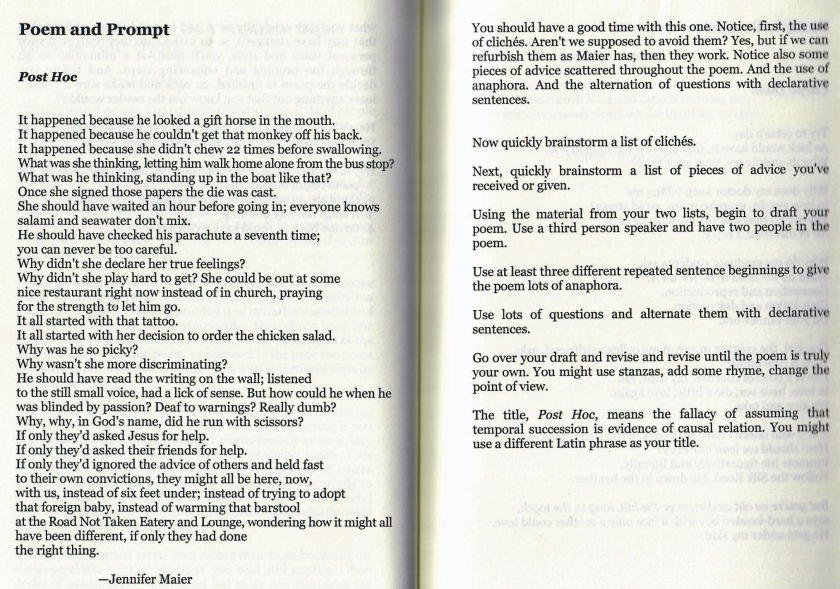
post-hoc

  • Label this CLASSROOM ASSIGNMENT #12
  • ANAPHORA: repetition of a word or words at the beginning of two or more successive verses, clauses, or sentences.
  • Read the poem above (left) and follow the instructions (right).
  • Brainstorm with a partner to create your lists.
  • Your poem must be at least 10 lines long.
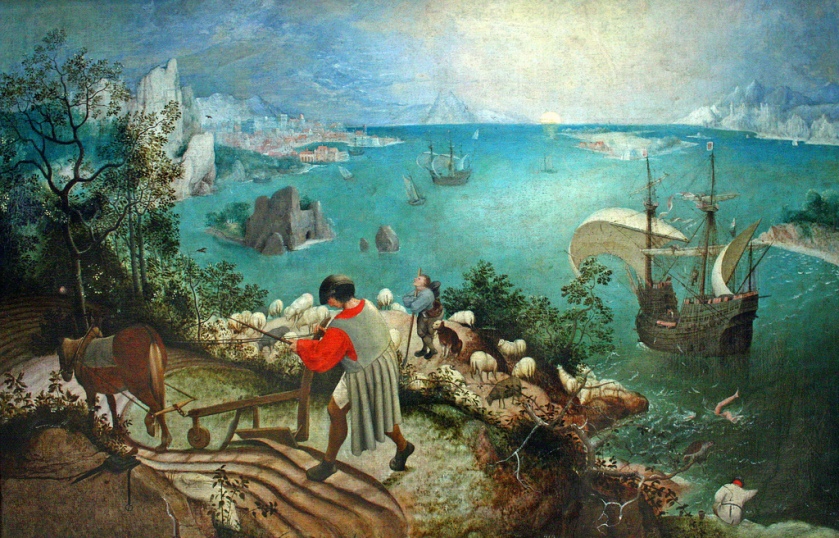
  • Next, write an ekphrastic poem. Ekphrasis sounds kind of complicated, but it’s just a fancy word for using a piece of art to inspire a poem. Use one of the images below to write your poem.
  • As with the cliche poem above, use ANAPHORA.
  • Your poem must be at least 10 lines long.
  • If you can’t finish both poems in class, finish them for homework.
  • Bring your textbook to our next class.

Some thoughts on how to begin your ekphrastic poem

  1. List the first words that come to mind when you look at this artwork.
  2. PLOT: What is happening in this artwork? What story is being told?
  3. CHARACTER: Who or what is the subject of the artwork? How would you describe them?
  4. SETTING: What is the mood of the artwork? What sounds, smells, feelings, tastes could you associate with it?
  5. How does this artwork connect with you personally? Why did you choose it?
  6.  MAIN IDEA: Now that you have closely observed the artwork, how would you summarize its main idea?

SAMPLE EKPHRASTIC POEMS BASED ON “LANDSCAPE WITH THE FALL OF ICARUS”:

Landscape with the Fall of Icarus

icarus

WAITING FOR ICARUS by Muriel Rukeyser

He said he would be back and we’d drink wine together
He said that everything would be better than before
He said we were on the edge of a new relation
He said he would never again cringe before his father
He said that he was going to invent full-time
He said he loved me that going into me
He said was going into the world and the sky
He said all the buckles were very firm
He said the wax was the best wax
He said Wait for me here on the beach
He said Just don’t cry

I remember the gulls and the waves
I remember the islands going dark on the sea
I remember the girls laughing
I remember they said he only wanted to get away from me
I remember mother saying: Inventors are like poets, a trashy lot
I remember she told me those who try out inventions are worse
I remember she added: Women who love such are the worst of all
I have been waiting all day, or perhaps longer.
I would have liked to try those wings myself.
It would have been better than this.

Muriel Rukeyser
TIP

Tip: Use Concrete Words Instead of Abstract Words.

Concrete words describe things that people experience with their senses.

  • orange
  • warm
  • cat

A person can see orange, feel warm, or hear a cat.

Poets use concrete words help the reader get a “picture” of what the poem is talking about. When the reader has a “picture” of what the poem is talking about, he/she can better understand what the poet is talking about.

Abstract words refer to concepts or feelings.

  • liberty
  • happy
  • love

“Liberty” is a concept, “happy” is a feeling, and no one can agree on whether “love” is a feeling, a concept or an action.

A person can’t see, touch, or taste any of these things. As a result, when used in poetry, these words might simply fly over the reader’s head, without triggering any sensory response. Further, “liberty,” “happy,” and “love” can mean different things to different people. Therefore, if the poet uses such a word, the reader may take a different meaning from it than the poet intended.

Change Abstract Words Into Concrete Words

Posted in Class Assignments and Homework

Class Assignment: November 2,3

Today your 10 Things Zine is due. Please put your completed zine on the front table. You will have time to browse the zines in class.

Label this CLASSROOM ASSIGNMENT #11

Today’s Prompt: Write a poem (at least 10 lines) based on the following news story. (This exercise is from page 350 of your textbook).  You are looking for a “skeleton, just the scaffolding on which you can build a poem. … Your job is to give the news story a life beyond itself.” In other words, you do not have to stick to the contents of the original article at all. Don’t worry at this point about rhymes or line breaks. Just work at condensing language so that you can tell your story in just one poem.

  1. Read the story and take notes.
  2. Write the poem: Use your poetic license to fill in the gaps, to tell your version of the truth, your perspective, maybe even your fabrication. Try to answer questions about the situation that the journalist would not ask.
  3. Poetic license: license or liberty taken by a poet, prose writer, or other artist in deviating from rule, conventional form, logic, or fact, in order to produce a desired effect.


After rescue from abuse, a drooly pooch named Hooch is 2016 American Hero Dog

Laura T. Coffey

hooch
  • Hooch, a French Mastiff who transformed into a drooling hunk of contentment and gratitude after surviving severe abuse, has been named American Humane’s 2016 American Hero Dog. The dog and the man who rescued him, Zach Skow of Tehachapi, California, received a thunderous standing ovation at a black-tie gala in Beverly Hills in September.
  • “It was an amazing moment — one of those moments I will 1,000 percent never forget,” Skow, 36, the founder of Marley’s Mutts Dog Rescue, told TODAY. “When I think about what we’ve both been through — eight years ago, I was almost dead — to be on stage representing this dog and my organization was unbelievable.”
  • Now the 2016 American Humane Hero Dog Awards, which honored Hooch and seven other hero dogs, is about to air on the Hallmark Channel on Friday, Oct. 28.
  • Skow said he struggled with alcoholism for years before he was diagnosed with end-stage liver disease in July 2008. He needed to be sober for six months to qualify for a liver transplant — and during that time of sobriety, he said he felt scared and suicidal.
  • “I had never lived without drugs and alcohol, and I had a tough time being trapped between my own ears,” he said. “But my dogs helped breathe life into me. They helped me get outside myself and be part of something bigger than myself.”
  • Around that period of transition, Skow established Marley’s Mutts Dog Rescue to help “the throwaways”: dogs with special needs and histories of abuse and neglect who land in animal shelters in and around Bakersfield, California. Marley’s Mutts has developed a network of foster homes and saved the lives of more than 3,000 dogs that had been facing euthanasia.
  • One of those dogs was Hooch, an emaciated and dehydrated stray who arrived at a Bakersfield shelter about three years ago. Shelter workers couldn’t get the dog to eat or drink; when they tried, he’d knock his food and water bowls around “like a maniac.” A vet visit revealed the shocking reason why Hooch couldn’t ingest anything: His tongue had been removed at its base at the same his ears had been badly cropped.
  • “It’s totally unfathomable,” Skow said. “My guess is he was probably barking or doing something his owner didn’t want him to do, and this was likely a punishment. Unfortunately we do see this around here.”
  • The veterinarian equipped Hooch with a feeding tube in his neck, and for about a month the dog received all his nutrition and water that way — until he ripped the tube out. Skow adopted Hooch and focused on helping him eat. Today, they have a system that Hooch loves: Hooch sits still and flexes his neck in just the right way. Skow mixes dry dog food with warm water and, very slowly and carefully, feeds Hooch by hand. Gravity takes care of the rest.
  • “Every now and then he’ll get some crunches in (with his teeth), and he likes that,” Skow said. “He was only 43 pounds when we got him and he’s 95 pounds now. … He’s definitely a goofball. He drools compulsively, like no other dog you’ve ever seen.”
  • Like many dogs rescued by Marley’s Mutts, Hooch serves as a therapy dog for humans hungry for support and compassion. Skow said Hooch is especially good with non-verbal children with autism. The dog also helps homeless people and prisoners with backgrounds of serious addiction.
  • “Hooch has never met a person he doesn’t like,” Skow said. “This dog is resilience personified. … It’s very humbling to see him living life on life’s terms and being triumphant.”
Posted in Cover Sheet

Fiction Cover Sheet

FICTION COVER SHEET–A story of at least 5 pages. Secure this packet with a spring clip.

DUE: MW class, November 21 (or earlier). TR class, November 22 (or earlier)

Choose from assignments  6, 7, 8, 9, or 10.

  • A story about a ceremony (Alexie)
  • A story about Pig Baby
  • A story based on something a character wants (this is completely open! You can essentially write any story you wish because, as we have seen, almost all stories are based on what a character wants). As author John Gardner has said, “In nearly all good fiction, the basic–all but inescapable–plot form is: A central character wants something, goes after it despite opposition (perhaps including his own doubts), and so arrives at a win, lose, or draw.”
  • A story based on a promise (Iktome)
  • A ghost story

Include in your packet, in this order

  1. This cover sheet
  2. The final draft of your story
  3. Class assignment 6 (clearly labeled)
  4. Class assignment 7 (clearly labeled)
  5. Class assignment 8 (clearly labeled)
  6. Class assignment 9 (clearly labeled)
  7. Class assignment 10 (clearly labeled)
  8. The following reading and writing exercise:

As author John Gardner has said, “In nearly all good fiction, the basic–all but inescapable–plot form is: A central character wants something, goes after it despite opposition (perhaps including his own doubts), and so arrives at a win, lose, or draw.

Read the following stories in your textbook: “Bigfoot Stole My Wife,” “The Little Knife,” “Beyond Lies the Wub,” and “Work.” For each story, answer these questions:

  1. What does the main character want? How do you know? Provide at least one quote for illustration.
  2. Does your main character make a choice? What is the choice?
  3. What is the resolution of the story? (The resolution is the consequence of the choice).
Posted in Class Assignments and Homework

Ghost Story: Workshop

  1. Do we know anything about the main character’s ordinary life? Do we know what the character wants? What does the character want?
  2. Is there an incident that pushes the main character out of his/her normal life? What is it?
  3. Does the main character have a goal? What is it?
  4. Does the main character make a hard choice? What is it?
  5. Can you identify the most dramatic moment in the story? What is it?
  6. Are there consequences for the main character’s choice? What are they?
  7. Does the main character change? How?
  8. Does the ghost have a motive? What is it?
  9. What form does the ghost take? What do you think of that?
  10. Does the ghost have any special powers? What are they?
  11. Are there any scary moments in the story? Where?
  12. How does the setting function in the narrative? Are there enough details for you to have a sense of place? What descriptions of the setting stand out?
Posted in Class Assignments and Homework

A Ghost Story

ghost

Label this Classroom Assignment #10

Write a ghost story that is set on this campus. Make your story completely fresh, nothing tired, predictable, or corny. Do lots of showing rather than telling. Ghosts are manifestations of our subconscious minds. In order to evoke terror in a reader, you have to reach into their subconscious, where their fears are already lurking. Hamlet is a great ghost story, and it’s high art, too. A young man, who is a dreamy college student, is suddenly confronted with his father’s ghost who says, “Avenge me.” Hamlet must then perform acts that are against his character, causing great conflict for him.

Just because it has a ghost in it doesn’t mean the story can’t have depth.

People won’t be afraid while reading your story just because it has a ghost in it. What people really fear is the unknown. Your character doesn’t have to see a ghost. Maybe he or she just hears it, feels it, or smells it. For a while, your reader, as well as your character, should be asking, “What is it?” Something otherwise friendly should be distorted. You need to have at least three encounters with the ghost, ranging from mild to extreme.

Fear isn’t the only important reaction in a ghost story. Enhance the fear with other emotions: sadness, depression, anger, hatred, jealousy.

Most of all, your reader must care what happens. This is the biggest factor in ANY story! You must develop interesting (and deep) characters. Your characters must seem like real people.

Before you start writing your story, work out some of the particulars:

  1. Protagonist.  Stasis. What is your character’s ordinary life like? At the beginning, what does your character want at the beginning of your story? What kind of person is your protagonist? What does the protagonist look like?
  2. Protagonist. Trigger. What pushes your character out of his/her normal life? Now what does your character want?  Usually a person who suddenly is aware of a ghost is going through some kind of angst or at least some kind of strong feeling. This depth of feeling makes the person more open to the supernatural. Give your protagonist a problem that he or she has to deal with. Weave this problem into your narrative.
  3. Protagonist. Quest. What is your character’s goal? What must your character do?
  4. Protagonist. Obstacles and surprises. What events happen along the way?
  5. Protagonist. Critical choice. What hard choice does your character make that demonstrates his/her character?
  6. Protagonist. Climax. The most dramatic moment in your story.
  7. Protagonist. Reversal. A consequence to your character’s critical choice.
  8. Protagonist. Resolution. Your character returns to ordinary life but is changed by the ordeal.
  9. Ghost. What is the ghost’s motive for existing and doing what it does? What does the ghost want?
  10. Ghost. Choose an unusual form for you ghost.What does your ghost look like? What powers does your ghost have?
  11. Fears. What situations would be the most terrifying? Note what scares you the most and why.
  12. Setting. Use locations that are the most discomforting. There should be a feeling of isolation, cutting off your character from help. Stories are often made scary through atmosphere. Many of them take place in old buildings and graveyards. We have a graveyard on campus! Your descriptions will have to be very chilling and grim. That is how you is will set your tone. But even more important is how you build the scenes. Remember that in suspense, it’s the details.

Remember, NO CLASS this Wednesday October 26 and Thursday October 27.

On Monday October 31/Tuesday November 1, bring TWO COPIES of your ghost story to class for workshop.

The 10 THINGS ZINE is due

  • MW November 2
  • TTh November 3

SPOOKY STORIES TO ENJOY:

  1. Henry James, “The Turn of the Screw”
  2. Algernon Blackwood, “The Willows”
  3. Washington Irving, “The Legend of Sleepy Hollow”
  4. Robert E. Howard, “Pigeons from Hell”
  5. Kelly Link, “The Specialist’s Hat”
  6. Ambrose Bierce “The Damned Thing”
  7. Edith Wharton, “Bewitched”
  8. F. Marion Crawford, “The Upper Berth”
  9. Edgar Allan Poe, “The Black Cat”
  10. Paul Ernst, “Death’s Warm Fireside”
  11. William Fryer Harvey, “August Heat”
  12. Mark Twain, “A Ghost’s Tale”
Posted in Critiques

Fiction Critique

Burning House

Yes, sometimes you have to burn down the house. Sometimes you have to start over. Sometimes, a piece just isn’t working. But in every piece, there’s something… something that proves YOU ARE A WRITER. As you critique, look for that something. Encourage your classmate. Be honest, absolutely, but also be tactful, and be kind, for you are treading on someone’s dreams. 

  1. What do you think the author’s intentions are with the piece, in terms of drama and theme?  In what ways does the author succeed in fulfilling this project?
  2. What areas need to be further developed or reconsidered in order to accomplish the author’s goals?  And what is your opinion of these goals?  Should they be pursued or re-considered?  In other words, should the story on the page be the story on the page?
  3. How are the elements of craft and technique operating?  For example, is the point of view used effectively?  Does the plot provide the drama necessary to sustain the story?  What are the stakes? Are they high enough? What are other options the author might consider?
  4. What are the external and internal conflicts of the story?  How do they work together in the story?  Are there ways to utilize them more effectively?
  5. What were the strongest points/aspects of the story, the areas that helped you understand and appreciate the author’s project?
  6. What questions does the draft raise—in terms of logic, drama, theme, etc.—that the author should be aware of?
  7. How is language operating in the story?  What are the identifiable trends, patterns, and qualities of the writer’s sentences, and how do they lend themselves toward the story’s narrative voice?
  8. What are the thematic possibilities of the story?  Should elements of craft (point of view, plot, dialogue, etc.) be reconsidered with respect to the possible themes of the work?
Posted in Class Assignments and Homework

Retelling

iktomi

Label this Classroom Assignment #9

Iktomi, the tricky spider man, was starving. There had been no game for a long time. Iktomi was just skin and bones. His empty stomach growled. He was desperate. Then, it occurred to him to go to Inyan, the rock, who has great powers,and who might answer his prayers.

Iktomi wrapped himself in his blanket, because it was late in the year and cold. Then he went to a place where a large rock was standing. This rock was very sacred. Sometimes people came to pray to it.

When Iktomi arrived at that place, he lifted up his arms to Inyan. “Grandfather, have pity on me. I am hungry. If you do not help me, I will starve to death.”

Iktomi took his blanket from his shoulder and draped it around Inyan. “Here, grandfather, accept this gift. It is the only thing I have to give. It will keep you warm. Please let me find something good to eat.”

After praying to Inyan for a long time, Iktomi went out in search for food. He had a feeling Inyan would answer his prayers, and he was right. Iktomi had not gone very far when he came upon a freshly killed deer. It had an arrow piercing its neck, the feathered nock sticking out on one side of the neck and the arrowhead on the other.

“Oh,” said Iktomi, “the deer has been able to run for a distance after being hit and the hunter has lost it. Inyan has arranged it that way. Well, that is only fair. Did I not give him my blanket? Well, anyhow, thank you, grandfather.”

Iktomi took a sharp knife out of its beaded knife sheath and began to skin and dress the deer. Then he gathered wood, and with his strike-a-light and tinder, made a fire. There was not much wood, and it was wet. It wasn’t much of a fire. And it had grown very cold. Iktomi was shivering. His teeth were chattering. He was saying to himself: “What good is my blanket to Inyan? He is just a rock. He does not feel either heat or cold. He does not need it. And, anyway, I don’t think Inyan had anything to do with me finding this deer. I am smart. I saw certain tracks. I smelled the deer. So there, I did it all by myself. I did not have to give Inyan anything. I shall take my blanket back!

Iktomi went back to the sacred rock. He took the blanket off him. “This blanket is mine,” he said. I am freezing. You don’t need this blanket; I do.”

Iktomi wrapped the blanket tightly around his body. “Ah, that feels good,” he said. “Imagine giving a blanket to a rock!”

When Iktomi came back to the place where he left the deer, he discovered that it had disappeared–vanished, gone! Only a heap of dry bones was left. There were no tracks or any signs that somebody had dragged the deer away. It had been transformed in to dry bones by a powerful magic.

“How mean of Inyan,” said Iktomi, “and how stupid of me. I should have eaten first and then taken the blanket back.”

LABEL THIS ASSIGNMENT CLASSROOM ASSIGNMENT #9

Write a story about someone who needs something badly, gives something precious in trade for it, and then takes it back. It’s most important that you capture the thought process the character goes through to justify taking the object back. Write at least two pages. Ideas…

  • A student needs an essay for a class. It needs to be a good essay because she is failing the class and might get kicked out of school. She goes to a friend and asks her to write an essay for her. She agrees give her friend something in return: what?
  • A man wants money so he can buy some drugs. He’s really desperate. He goes to his grandmother and agrees to do work (something really hard or demeaning) for her in trade for the money.
  • A man is in the desert. He is dying of thirst. He meets a poor woman who is carrying a jar of water. He trades (what?) for the water.
  • A woman astronaut is on a strange planet. It is cold and she needs shelter and warm clothing. She meets an alien and trades (what?) for both of these.
  • A soldier is afraid she will die in an upcoming battle. She prays to God, saying that if God lets her live, she will go to church every Sunday when she gets home.

IMPORTANT: During our next class, I’d like to have a small group fiction workshop. For this workshop, bring two copies of a story based on classroom assignment 6, 7, 8, or 9. These must be hard copies. You may single space the copies to save paper. 

Posted in Class Assignments and Homework

Class Activity for October 12, 13

sexy-red-dress

Label this Classroom Assignment #8

So far we have practiced two important techniques of fiction: conflict and entering a character’s skin. Tonight, I want you to focus on metaphor.

Using the pig baby character (or another character of your choice), write a page  explaining what your character wants. Kurt Vonnegut once said that you should make every character in your fiction want something, even if it’s just a glass of water.

Choose one thing that your character wants. It should be a concrete object that is symbolic of a deeper want. It should be something like a RED DRESS. Write about it. Choose something else and go through the process again. So that’s two pages, at least. Each page describing a different thing your character wants.

Don’t worry too much in the beginning about the symbolism. You don’t have to have that figured out ahead of time. Just think about a plausible object that your character would want. Let the symbolic value of that object evolve as you write.

Employ the palimpsest method, using the following poem as a model. (Don’t write a poem, however. Write in prose). In the palimpsest method, you impose new words on top of the model words. Begin at the beginning and go line by line, doing what the writer of the model piece has done. Allow yourself to digress from the poem at intervals but keep coming back to it for structure. Use every line. Capture the repetition of “I want, I want, I want.” Include specific details like “Thrifty’s,” “Mr. and Mrs. Wong selling day-old donuts,” and “the Guerra brothers.”

Can’t think of anything? Try one (or two) of these:

  • an aquarium
  • a balloon
  • a backpack
  • a BB gun
  • a parrot
  • a stopwatch
  • a tuba
  • a microscope
  • a king size bed
  • a Barbie
  • a bobble head (your choice)
  • a corpse plant
  • a tulip bulb
  • a tattoo of ____________

What Do Women Want?

I want a red dress.
I want it flimsy and cheap,
I want it too tight, I want to wear it
until someone tears it off me.
I want it sleeveless and backless,
this dress, so no one has to guess
what’s underneath. I want to walk down
the street past Thrifty’s and the hardware store
with all those keys glittering in the window,
past Mr. and Mrs. Wong selling day-old
donuts in their café, past the Guerra brothers
slinging pigs from the truck and onto the dolly,
hoisting the slick snouts over their shoulders.
I want to walk like I’m the only
woman on earth and I can have my pick.
I want that red dress bad.
I want it to confirm
your worst fears about me,
to show you how little I care about you
or anything except what
I want. When I find it, I’ll pull that garment
from its hanger like I’m choosing a body
to carry me into this world, through
the birth-cries and the love-cries too,
and I’ll wear it like bones, like skin,
it’ll be the goddamned
dress they bury me in.

–Kim Addonizio
Posted in Class Assignments and Homework

Class Activity for October 5,6

pig-baby

REMINDER: Your 10 things zine is due:

  • MW November 2
  • TTh November 3

Today’s task: Entering another’s skin.

Classroom Assignment #7

Fiction writers have to be able to inhabit another person’s skin, to imagine what it’s like inside the mind of another. Today you will write an experimental piece based on “Sister Francetta and the Pig Baby” by Kenneth Bernard.

You will write from the point of view of the pig baby and devote at least one paragraph each to the following periods of the pig baby’s life (15 paragraphs in all). What you don’t finish in class today, finish for homework:

  • birth
  • first memory
  • first day of school
  • recess
  • lunch
  • school picture day
  • valentine’s day
  • first crush
  • first date
  • prom
  • graduation
  • first job
  • your choice
  • your choice
  • your choice
Posted in Class Assignments and Homework

Class Activity for Oct. 3,4

jimmyhendrix1-1

You can watch Jimi Hendrix play “The Star-Spangled Banner” here:

Label this Classroom Assignment #6

Homework for next class: Read “Sister Francetta and the Pig Baby,” page 369. 

Today, you will work to develop conflict within a story. Conflict is at the heart of the short story. Without conflict there is no tension and without tension, your reader will lose interest in the story.

In Sherman Alexie’s story, “Because My Father Always Said He Was the Only Indian Who Saw Jimi Hendrix Play ‘The Star-Spangled Banner’ at Woodstock,” he outlines a ceremony that the speaker performs in an attempt to get close to his alcoholic father. (see page 145).

Tonight, I want you to write a story (at least three double spaced pages) about a ceremony, using the following rules:

  1. It should be written in first person.
  2. It should involve two main characters, the speaker and one other. These can be any two characters: ones you make up tonight or, for you “real” writers out there, ones you’ve worked with in the past. Before you ever start, figure out the relationship between the two characters. 
  3. The characters should know each other considerably well: father/son, mother/daughter, lovers, best friends, etc.
  4. The whole story will consist of the speaker describing a ceremony that involves the two main characters. It can be any kind of ceremony. Something as elaborate as a wedding or as simple as Trick or Treat or tossing a ball to each other or washing dishes or preparing a meal or planting a garden. 
  5. The ceremony should be a palpable experience for the reader. Alexie only has to mention “The Star-Spangled Banner” at Woodstock because anyone who has see it, remembers. Alexie has chosen to evoke Woodstock because it was a revolution against war crimes (similar to crimes committed against the Indians). His choice broadens the conflict from father/son to Indians/U.S Government. It also points to the conflict that exists between his parents. Alexie’s father is an alcoholic, and we can’t forget that Hendrix died after drinking too much alcohol. Think about how your ceremony might add another layer of meaning to your story.
  6. Use sensory and descriptive details, similes and metaphors.
  7. Conflict: There is something wrong between the two characters that gets revealed as the ceremony is described. In order to build tension and suspense, there should be some doubt about the outcome. Don’t tie up things too neatly at the end. In real life, things don’t usually work that way. Suggestions:
  • The speaker has a secret.
  • The other character has a secret. The speaker knows the secret but the other character doesn’t know that.
  • The other character has a problem and the speaker wants to help but doesn’t really know how.
  • The speaker has a problem and wants help but doesn’t know how to ask for it.
  • Something terrible has happened during the day and the speaker is trying to figure out how to tell the other character. 
  • The other character has disappointed the speaker in some profound way but doesn’t know it.  Or the speaker has done something that the other character would be disappointed about.
  • The inner conflict should be mirrored in some way in the ceremony. For example, if the two characters are tossing a ball back and forth, one of them throws the ball too hard or too fast or drops the ball. 
  • Don’t leave until you have written at least three pages of your story!
Posted in Critiques

Your First Workshop: Rough Drafts

MEANING OR ABOUTNESS

§ What is the piece about? State what you think the essay is about in one sentence.

§ Is the essay’s “aboutness” SHOWN not TOLD? Are specific illustrations and examples provided instead of just an overview of what happens?

§ Is the leap of significance made for the reader?

TENSION

§ Where does the tension in the essay lie?

§ Are there several kinds of tensions at work?

§ Are there tensions left unresolved?

TIME

§ How has the writer treated the movement of time?

§ If there are varying time periods, does the writer move the reader through it smoothly, effectively?

SENSE OF PLACE

§ Is the setting rendered in sensory detail? Do the details heighten the atmosphere?

§ Are they authentic, believable?

§ Does the author’s treatment of the setting enhance the reader’s understanding of what the essay is about?

CHARACTERS (the same litmus test as fiction and this includes the first person (I) of the nonfiction essay)

§ What complexities do they reflect?

§ What details of the lives move you?

§ Identify details, actions, speeches that enhance the essay’s sense of character.

DIALOGUE

§ Identify dialogue in which the characters’ voices seem especially in tune with who they are.

§ Is there any dialogue that doesn’t ring true or seem believable? Forced?

§ Does the dialogue move the story, inform the reader and characterize?

§ Too much dialogue?

§ Too little dialogue?

VOICE

§ Is the tone of the essay consistent?

§ Do the words, sentences, rhythms used hit the same note?

§ Do the words, sentences, etc. suit the time, place, situation?

SCENE

§ Consider the way in which the writer has used the fictional element of scene.

§ Is each scene fully rendered? Any missed opportunities?

§ Any parts of the essay that would be better enhanced by the use of scene?

COMPOSITION LOGIC/NARRATIVE STRATEGY

§ What is the logic behind the way in which the writer has presented the world of the essay?

§ Is there another sequence or structure that might be better suited to the material?

EMOTIONAL OUTLINE

§ Is there an emotional thru-line?

§ Is the emotion in synch with the movement of the story?

TRANSITIONS

§ Where are they?

§ How do they work to make the story of the essay vivid and continuous?

§ Are there places that need stronger transitions?

THE OPENING

§ How does the first line, the opening paragraph prepare readers for what the essay will be about?

§ What promises does it make to the reader?

§ Does the opening break the contract with the reader?

§ What evidence of the “about” is found at the beginning?

THE END

§ In what way does the essay come full circle?

§ Is the ending satisfying?

CLARITY OF THE PROSE

§ Do the sentences actually say what you mean?

§ Any awkward sentences, paragraphs?

TITLE

§ Is it effective? Appropriate?

§ How could it be better?

Some others to consider:

§ Did you like the essay? Why or why not?

§ What works well? What does not?

§ Were you genuinely interested in what happened in the essay? Why or why not?

§ Are there grammatical errors, misspellings?

§ Is there awkward language or metaphors that don’t work?

§ Are there parts of the essay that retard movement or have no purpose?

§ Can the essay be trimmed?

§ Expanded?

§ Is this the most effective order of scenes?

Posted in Class Assignments and Homework

Your First Workshop

We will be workshopping rough drafts of your CNF pieces on the following days:

  • September 26 (MW class) Rough draft of Creative Nonfiction essay is due
  • September 27 (TR class) Rough draft of Creative Nonfiction essay is due

Rough draft means that you have made the draft as good as you can without feedback.

You will need to bring 4 copies of your rough draft to class. You will be put into small groups. You will give a copy of your essay to each member in your group. It can be single spaced and printed on both sides of the paper.

From your textbook, pages 3 and 4:

  • Writers want to record, share and enlighten readers with a distinctive perspective on exceptional subjects.
  • Our brains are overstimulated. It’s hard to make an impression on readers. The written work must “astonish and amaze.”
  • Writers have to find an imaginative way of communicating their experience, their life.
  • The subject matter is life “as we are living it.”
  • The creative aspect of CNF: vivid language and surprising insight. 

Class activity: isolate the two creative aspects of CNF in “The Undertaking,” “The Ninth Tuesday,” and “101 Ways to Cook Hamburger.” Where do you find: vivid language and surprising insight?


Posted in Class Assignments and Homework, Zines

Zine Diary: The Ten Things

outsider4

DEAD GUYS by Matthew Swan. Self-published

A finished copy of your zine diary is due:

  • MW November 2
  • TTh November 3

On your class day, you will share your zine with the class.

This zine is based on the graphic novel 101 Musicians to Listen to Before You Die by Ricardo CavoloHe calls this work a “music diary.” In the book, Cavolo illustrates the musicians that have meant the most to him and, in a personal way, explains why.

For your zine, I want you to write about and illustrate at least 10 of your favorite things.  It will work best if your 10 things are all of a same type: books, movies, actors, characters, monsters, toys, artists, etc.  It should be 10 things that you really, really like.

How you present the material is up to you, but each of your “things” must include both text and image. You must also include an introduction that explains what you wanted to accomplish with your project and a table of contents. All text must be done by hand.

Cavolo’s Introduction:

cavolocavolo-001

Notice that the hand printed text doesn’t look “perfect.” I think the raw imperfection of the printing gives the book an endearing quality.

Here are some samples from Cavolo’s work:

cavolo1cavolo2cavolo3cavolo4

cavolo5cavolo6

A word about drawing. You may be saying, “I can’t draw.” But everybody can draw. You drew when you were child. You made worlds on paper. You still can. Cavolo has something to say about “Outsider” art (typically, those labeled as outsider artists have little or no contact with the mainstream art world or art institutions). I’ll quote Cavolo, because I agree with what he says 100 %:

Outsider Art and Folk Art are my favourite types of art, because they are the purest. No silly marketing concepts on these artists’ minds. They work solely for fun, or sadness, or happiness, or love, or hate… and with these pure feelings you obtain the most powerful pieces. This way of creating art is so direct that it has the power to leave me shocked. So many times I have stood in front of a piece and I don’t know what to say. I just smile, or feel a big punch in my stomach, or suddenly I feel so sad, or I fall in love with that artist. That is what we demand from art, to be moved. And I have to say there are not so many pieces of art that give me those feelings. But Outsider Art doesn’t fail, it always gives me that, and even more.

So you see, if you work solely for fun, sadness, happiness, love, or hate, if you bring your pure feelings to the page, you will create exceptional art.

More samples of Outsider Art

outsider

John “Jack” Savitsky

outsider2

Jesse Reno

outsider-3

Charles Daniels


Posted in Class Assignments and Homework, Zines

How to Make a One Page Zine

A zine is a small circulation self-published work of original or appropriated texts and images usually reproduced via photocopier. Profit is not the primary intent of publication.

Zines are written in a variety of formats, from desktop published text to comics to handwritten text.

Topics covered are broad, including fanfiction, politics, poetry, art and design, ephemera, personal journals, social theory, single-topic obsession, or sexual content far outside of the mainstream enough to be prohibitive of inclusion in more traditional media.

Today we will make a one page zine based on one entry from your “I Remember” exercise.

  • ABOVE: Ruggles and his mini-zine
  • BELOW: “I REMEMBER” ZINE by  Sarah Renee Keller

keller-faith1keller-faith-2keller-faith-3keller-faith-4keller-faith-5

“Based on the style of Joe Brainard’s memoir I Remember, this mini zine is a small collection of statements in which I remember my life from being a young Christian girl to being a young woman with no need for God.” –Sarah

HOMEWORK:

  • Keep your original zine always.
  • Make 4 copies of your zine (use a scanner or photocopier).
  • Bring your printed, folded zines to class.
  • I will keep one zine from each person for my personal collection.
  • The rest are to trade in class.
  • Bring 10 sheets of paper to class. It can be any kind of paper, but remember: If you are using markers, they will bleed through thin paper to the other side.  Bring your art materials: markers, scissors, color pencils, collage materials, tape glue, etc. Whatever you want to use. We will be making a larger zine based on the “I Remember” exercise.
  • For next week: read “The Undertaking” (p. 5), “The Ninth Tuesday” (p. 13) and “101 Ways to Cook Hamburger” (26). Ask yourself, what makes these essays engaging? Make a list of “what works” in each essay.
Posted in Cover Sheet

Your first workshop

NAME _________________________________________________________________

From your syllabus:

  • September 26 (MW class) Rough draft of Creative Nonfiction essay is due
  • September 27 (TR class) Rough draft of Creative Nonfiction essay is due
  • October 3 (MW class) Final draft of Creative Nonfiction essay is due
  • October 4 (TR class) Final draft of Creative Nonfiction essay is due

Your first workshop is on September 26/27. For this workshop, you should bring four copies of a rough draft of a creative non-fiction piece to class.

You will be put into groups of 4. You will exchange drafts with the people in your group, read the drafts, and provide feedback on the drafts.

You may draw from any of the prompts that we have done in class.

  • The autobiographical object
  • Any question from classroom assignment #2
  • The mashup assignment
  • The babadook assignment
  • The “I Remember” assignment. (For this prompt, you may write about one entry that you generated.)

The prompts helped you to generate material. As you shape this material, feel free to make any changes or adjustments you deem necessary.

HOW TO TURN IN YOUR FINAL DRAFT:

  1. Copy and paste this assignment sheet into a Word document and print it out. Place it on top of your assignment.
  2. Next comes your final draft. Double spaced, Times New Roman Font. At least five pages. You may print on both sides of the paper.
  3. Next comes each class assignment in order: Classroom Assignment #1, Classroom Assignment #2, Classroom Assignment #3, and Classroom Assignment #4. Do not include the “I Remember Exercise.” We’ll be doing something else with that exercise, so no need to print them out just yet.
  4. Secure all work with a spring clip.
  5. Turn work in on time in class. You will receive feedback on your work within two weeks. I don’t grade creative work. Your grade is based on attendance/participation/ effort/willingness to try new things.
Posted in Class Assignments and Homework

Class Assignment September 8/12

joe
Artist Joe Brainard Sitting on Fire Escape — Image by © Christopher Felver/CORBIS

More about Joe: Joe Brainard

Label this assignment Classroom Assignment #5

From Poets.org

I don’t ever have an idea. The material does it all. You have a figure and a flower and you add a cityscape and it makes the story. You have control if you want to take it but that’s something I never wanted to do much.

joe-2

A completely original book. — Edmund White

Each detail seduces and reveals while remaining entirely true to the unsentimental demands of the form itself. — San Francisco Bay Guardian, January 31, 2001 –Noel Black

…a masterpiece…Joe Brainard’s modest little gem will endure. …both uproariously funny and deeply moving. — Paul Auster, 1995

…he had happenend onto something wonderful…Joe’s originality came from the fresh way he looked at things. — Ron Padgett

…universal appeal. He catalogues…fashion and fads, public events and private fantasies, with such honesty and accuracy and in such abundance… — The Voice Literary Supplement, –Michael Lally

Brainard made art for the same reasons the New York School poets wrote: for the pleasure of it. As he said of collaboration, “it’s fun,” … The book  I Remember is the riotous, poignant, earnest and seemingly random result [of Brainard’s process]. Painterly in its vivid details and collagist in its hands-off juxtaposition, it is an accumulative, oblique biography, a portrait of the artist as a young man. It is much, much greater than the mere sum of its parts. Ashbery referred to it, only half-jokingly, as “humane smut.” It has that sweet, playful self-possession that pervades Brainard’s work.

A sampler:

I remember my first erections. I thought I had some terrible disease or something.

I remember the only time I ever saw my mother cry. I was eating apricot pie.

I remember when my father would say “Keep your hands out from under the covers” as he said goodnight. But he said it in a nice way.

I remember when I thought that if you did anything bad, policemen would put you in jail.

I remember when polio was the worst thing in the world.

Today you are going to create your own “I Remember” document. The rules:

  • Before leaving class today you will write 100 “I Remember” entries.
  • Each entry MUST begin with the words “I Remember.”
  • You must be honest. Whatever comes into your mind, you must write it down.
  • You should not reorder the entries. They should stay in the same order that you created them.
  • No memory is inconsequential. No experience too small. If you remember it, write it down.
  • For homework, write 50 more “I Remember” entries
  • P. S.: It’s okay to revisit material in subsequent entries, as long as the memory is written in a different way, for example: you develop the idea more fully, you admit to a different feeling associated with the memory, etc.
  • Bring your list with you next class, along with one sheet of computer paper and art materials: scissors, markers, color pencils, etc.


Posted in Class Assignments and Homework

Class Assignment September 6/7

babadook

The Babadook

The Babadook is a 2014 film written and directed by Jennifer Kent.  The Babadook is a creature that takes over the mind of Amelia Vanek. It represents the horror of how she lost her husband and it stands between her and her young son’s relationship. 

Label this assignment Classroom Assignment #4

Today you will write a piece like “Creatures On My Mind.”

That is to say your essay

  • Will be made up of three parts
  • May draw from the questions you answered earlier in class, but does not have to
  • May draw from your last homework assignment to write two pages about one of the questions you answered in class, but does not have to
  • Will be made up of three parts about the same subject, like “Creatures On My Mind”
  • Will be made up of parts that portray three different experiences in your life regarding this subject
  • For example: Three times you felt powerful / Three books or movies that changed your life / Three times you were angry / Three stories that illustrate what you would most like to change about yourself, etc.
  • Will be ordered like this: from least important episode to most important episode
  • Will employ qualities of good story writing, such as sensory and descriptive details, similes and metaphors.
  • Will be at least 150 words long (today). Essay can be developed further out of class, but only if you wish.

After you have written your piece, look for aspects of the writing that hold the three parts together. Is there something you can do to help bring the three threads together?

NO NEW HOMEWORK

Next class is very important. We will do a prompt that will lead to your very own handmade zine.

Posted in Class Assignments and Homework

Class Assignment Aug 31/Sept 1

its-alive

RIP GENE WILDER 😦

Label this assignment Classroom Assignment #3

What is a “mashup”?

A mashup takes information from two or more sources and presents it in a new way.

It’s sort of like creating Frankenstein’s monster. A bit from here, a bit from there. Think of your writing as a monster you want to bring to life. A monster that’s going to smash old ideas.

I want you to attempt to do a mashup of the information you have on your topic and the questions you recently answered about yourself. (You may have to answer some of the questions again so they will work with your topic.) Here are the questions again:

Has a book ever changed your life? If so, which one and why?
Has a relationship ever changed your life? When, how, why?
Describe a friendship you wish you had. Why?
Describe a friendship you wish you had never had. Why?
What is the angriest you’ve ever been? When? Where? Why?
At what moment in your life thus far have you felt the most powerful? Describe the incident, recalling how it made you feel and why.
At what moment in your life did you feel a sense of wonder and awe. Describe the incident, recalling how it made you feel and why.
What would you like most to change about yourself ? Why?
What would you like most to change about the future world? Why?
What would you most like to change about the world’s past?
  • First, answer the question that you formulated about your topic during our last class. A brief response will do.
  • Next, attempt the mashup. What you are essentially doing is explaining why your topic is so interesting to you. A Creative Non Fiction piece often is not so much about the topic as it is about the writer. Use your imagination. You are in charge! See what new ideas come to you. As in chemistry, when you mix two things, another thing is created. A + B = C, a brand new thing. It may be challenging to find a way to make them work. That’s okay. That’s the point.
  • EXAMPLE: I would choose the question about what I would like to change about myself. My answer would be that I want to be more courageous in my art. Then I would talk about how Andy transformed himself, through his art. *Note: anything that you really love affects you, changes you in some way. Perhaps talk about that. Why you need this person/place/thing in your life. What draws you to the topic, like a moth to flame. What he/she/it gives you. How he/she/it helps you somehow. 
  • Finally, share your mashup paragraph with the person next to you. Read your paragraph aloud to your classmate. Offer praise and suggestions.

HOMEWORK FOR NEXT CLASS:

  • Read “The Creatures on My Mind,” p 84
  • Be sure to bring your textbook to next class.
  • Develop one of your responses to the questions about yourself more fully. Include lots of descriptive and sensory details. Let us see, hear, feel, smell, taste. Put us inside the action. Write at least TWO pages.
  • Bring your two pages AND all of your responses to the questions about yourself.
Posted in Class Assignments and Homework

Class Assignment for August 29/30

ANDY WARHOL

Topic + You = Interesting essay

The purpose of this assignment is to integrate aspects of yourself with the topic you chose from your homework assignment.

Label this assignment Classroom Assignment #2

First, answer the following questions. You should write a short paragraph for each response (even if the answer is “no”). (25-30 minutes)

Has a book ever changed your life? If so, which one and why?
Has a relationship ever changed your life? When, how, why?
Describe a friendship you wish you had. Why?
Describe a friendship you wish you had never had. Why?
What is the angriest you’ve ever been? When? Where? Why?
At what moment in your life thus far have you felt the most powerful? Describe the incident, recalling how it made you feel and why.
At what moment in your life did you feel a sense of wonder and awe. Describe the incident, recalling how it made you feel and why.
What would you like most to change about yourself ? Why?
What would you like most to change about the future world? Why?
What would you most like to change about the world’s past?

NEXT…

  1. Create a question about the topic you chose to research for your homework assignment. You can base your question on any question above or make up your own question. For instance, if I chose Andy Warhol, my question might be: Truman Capote said he thought Andy Warhol was “just a hopeless, born loser.” How did Warhol transform himself into arguably the most important artist of the last half of the 20th Century? Why did I choose this as my question? Because I’m very interested in how artists transform themselves from being a “nobody” to being a successful artist. I’m interested in how I might transform myself, always, into a better and more productive artist and writer. (5 minutes)
  2. Write your question at the top of a new page of paper or computer document.
  3. After you have written your question on your paper/computer, write your question on the front board of the classroom. Put your full name after your question. (5 minutes)
  4. After everyone has written a question on the board, choose any question not your own and answer it on a sheet of paper. Try to write at least a paragraph. Put your name on the paper and give it to the person who created the question. (5 minutes)
  5. Fini!

FOR NEXT CLASS, BRING YOUR TEXTBOOK AND THE RESEARCH YOU DID ON YOUR TOPIC.

Posted in Class Assignments and Homework, Tips

Class Assignment for August 24/25

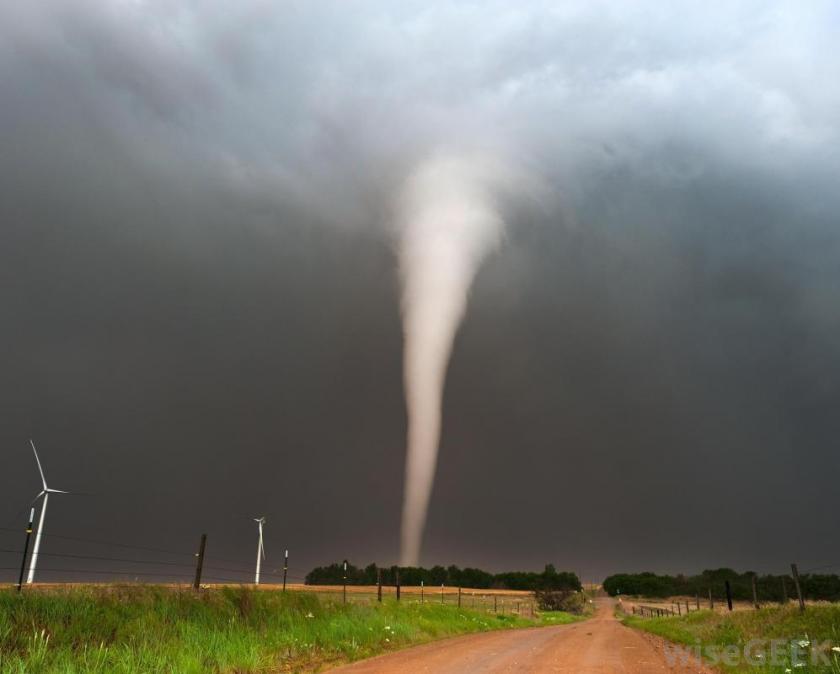
tornado

Label this assignment: Class Assignment #1

Write about your object from two points of view:

  1. From the point of view of a being from a different universe who knows nothing about Earth. Try to guess who would use it, what purpose it might serve, how an earthling might interact with it, how it might be used, etc.
  2. From the point of view of the object itself. Important: choose one person that the object is talking to. Consider: with whom is your object speaking? Why is the object speaking? When is this all taking place? What does the object want? What is keeping the object from having what it wants?
  3. Type your prompts. Save them. You will have to print them out and turn them in with your portfolio at the end of the semester.

HOMEWORK FOR AUGUST 29/30

  1. Read: “The Autobiographical Object,” p. 121+; “Discussion of the Genre,” p. 3-4; and “Not a Butterfly,” p. 106+.
  2. Consider people, places, or things that you are curious about and maybe somewhat obsessed about. People can be real or fictional. So can places. Make a list of these things. Examples: moths, Boston Terriers, Narnia, San Francisco, Orchids, Andy Warhol, Vampires, etc.
  3. Do not choose anything abstract, like psychology, expressionism, realism, pop culture, etc.
  4. Choose one item from your list. This will be the subject of your next prompt.
  5. RESEARCH: Do some research on your topic. Find books and articles about it.
  6. Bring your topic and your research with you to class.

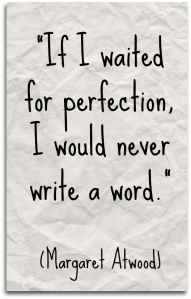
atwood

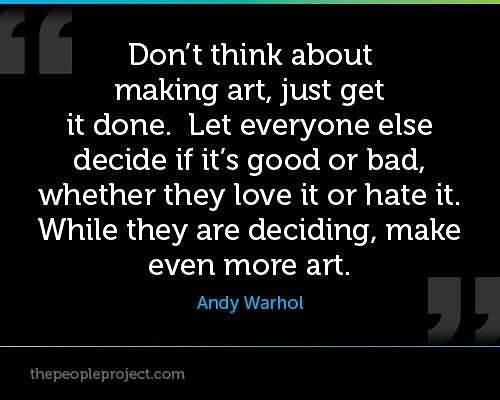
Tip #3: Don’t think too much while attempting these assignments, at least not in the early stages. Many of these prompts will not progress beyond the freewriting stage. If a prompt just doesn’t work for you, don’t worry. Do your best and then let it go. 

Posted in Tips

Day 1

Tip #1

An artist is only an artist on condition that he neglects no aspect of his dual nature. This dualism is the power of being oneself and someone else at one and the same time.

Charles Baudelaire

  1. HOMEWORK: Buy your book.
  2. Bring an object to class that has meaning for you.